
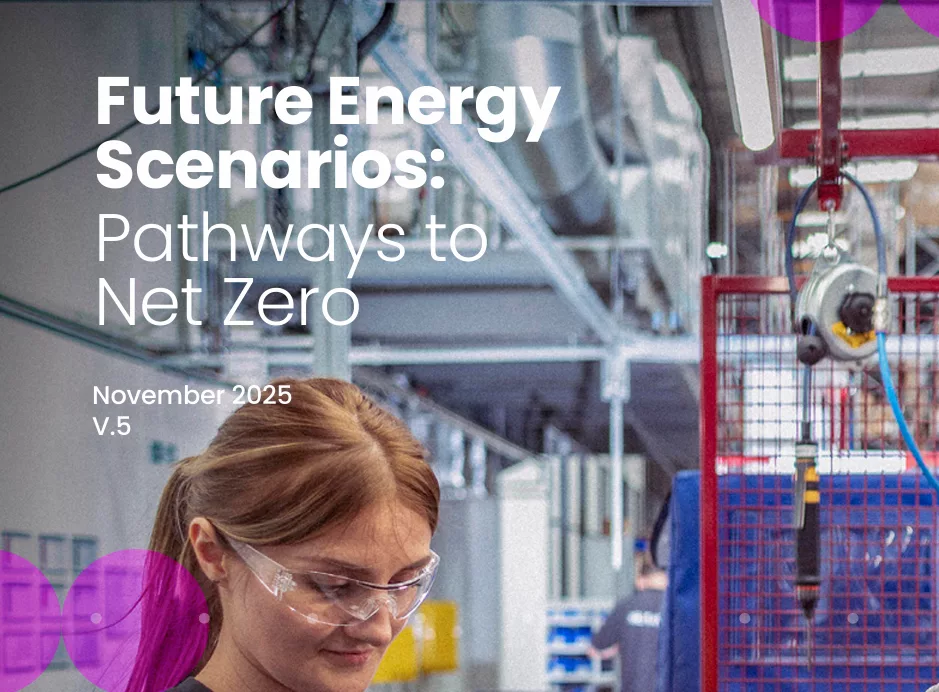
The UK’s path to net zero is entering a decisive phase. According to the National Energy System Operator’s Future Energy Scenarios 2025 report, the transition now hinges not just on generating clean energy, but on where, when, and how we store and deliver it. Energy storage, hydrogen infrastructure, and intelligent grid technologies are emerging as the linchpins of a resilient, flexible energy system.
Meeting Demand with Storage











With the electrification of heat, transport, and industry accelerating, peak grid demand is forecast to double by 2050. To meet that with renewables, the UK will need significant storage capacity. Some scenarios estimate a requirement of up to 205 GWh- over five times current levels. Battery systems will provide much of this capacity. However, long-duration storage is also crucial.
Invinity and Long-Duration Solutions
Invinity Energy Systems is scaling up production of vanadium flow batteries. These offer up to 12-hour discharge durations and don’t degrade like lithium batteries. Their systems already support grid resilience in the UK and Australia. Furthermore, co-location with solar farms is becoming increasingly common. This long-duration storage is essential for managing intermittent wind and solar generation. Renewables may soon supply over 70% of electricity.
Hydrogen Scaling with ITM Power
Hydrogen will play a central role in the transition. Electrolytic hydrogen production is expected to grow from zero today to 173 TWh by 2050 under the “Hydrogen Evolution” pathway. ITM Power is well-positioned to lead. Their PEM electrolysers are already operating in multiple UK hubs. The company aims to deliver multi-megawatt and even gigawatt-scale systems. Its Sheffield Gigafactory represents the industrial scale needed to hit net zero targets.
Smart Grids and Siemens Energy
Storage and hydrogen will not be enough on their own. Future energy demand will be highly dynamic. Smart homes, electric vehicles, and responsive industrial loads will shape usage. This is where digital grid control becomes vital. Siemens Energy is at the forefront of innovation here. They are developing AI-driven tools for real-time grid optimisation. Smart substations and bidirectional power flows are also part of their strategy. These advances will help manage decentralised supply and shifting demand.
From Fossil to Flexible
The 2025 FES pathways confirm the shift away from a centralised, fossil-fuel system. What follows must be cleaner, decentralised, and far more flexible. Achieving this will require more than just investment. It demands strategic alignment. Innovators like Invinity, hydrogen leaders such as ITM Power, and system enablers like Siemens Energy must work in coordination.
#EnergyStorage #HydrogenEconomy #SmartGrid #GridScaleStorage #NetZero2050
2
Jan 26
Grid Innovation to Power Net Zero
2
Jan 26
Hydrogen‑Fuelled CCGT: A Grid Stability and Storage Game‑Changer
12
Dec 25
UK Energy Costs to Halve by 2050
2
Nov 25
Wind’s Record Year Powers Ahead
1
Nov 25


