
The UK’s decision to transition to a renewable-led energy system could halve national energy costs over the next 25 years. The National Energy System Operator (Neso) forecasts system-wide costs will fall from around 10% of GDP today to 5-6% by mid-century.











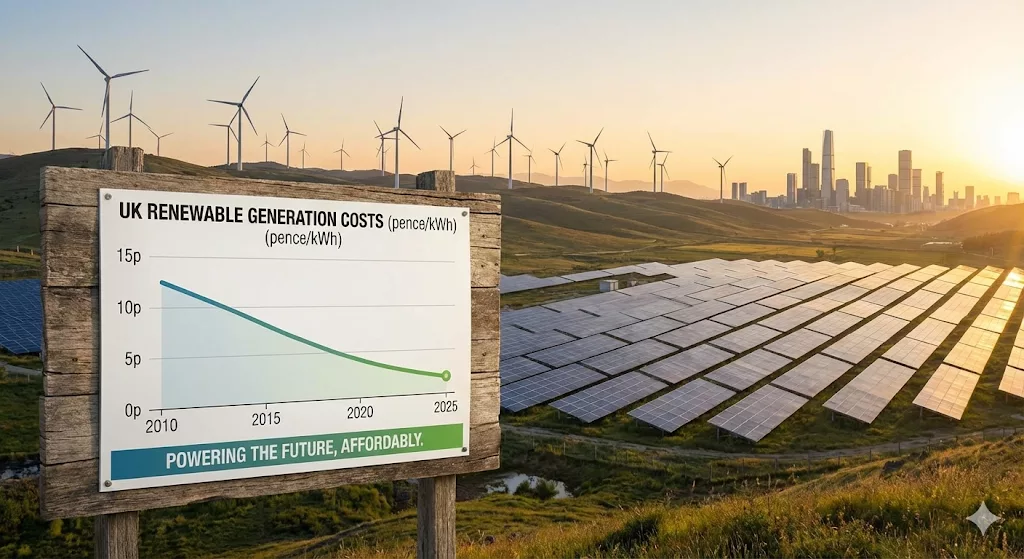
The shift is driven by structural electrification, reduced fossil fuel imports and sustained investment in renewables. Energy storage and hydrogen also play their part. In 2023 the UK spent nearly £50bn on oil and gas – mainly for transport, heating, and industrial use. This is down from over £100bn in 2022. Even under high-demand scenarios, energy costs are projected to fall to around £220bn per year by 2050. This is down from a peak of over £350bn during the transition period.
This macroeconomic trend provides a clear case for continued decarbonisation. Neso’s modelling does not directly address household energy bills. It is clear though that the broader reduction in national energy spend and exposure to volatile global fossil fuel markets implies a more stable and secure energy future.
Grid Constraints
The route to this lower-cost future is not without complications. One of the most pressing challenges that needs to be addressed is the capacity of the UK’s National grid. As renewable generation increases, the grid is struggling to keep up with the pace of change. In 2022 and 2023 the UK saw record levels of renewable curtailment – where wind or solar farms are paid to stop generating because the grid cannot absorb the power. According to National Grid ESO curtailment costs exceeded £1bn in 2023 alone.
This inefficiency points to a critical bottleneck in the energy transition – transmission infrastructure. The UK’s National Grid was not designed for distributed, weather-dependent generation. Wind farms in Scotland for example produce far more electricity than can currently be exported to demand centres in England. Grid upgrades and new high-voltage connections are essential to unlock the full value of existing and planned renewable projects.
Smart Grids and Batteries
Siemens Energy and Fluence Energy are actively developing solutions in this space, including smart grid technologies and grid-scale battery systems. These reduce the need for curtailment and enhance system flexibility. Investment in grid modernisation is also seen as key by infrastructure funds such as Harmony Energy Income Trust. They are building large-scale battery storage linked to renewable generation.
Companies such as Ceres Power and ITM Power are developing the electrolysis and fuel cell technologies necessary for this transition to a hydorgen economy. Meanwhile, vanadium flow battery developers such as Invinity Energy Systems offer long-duration storage critical for managing intermittency.
Renewables – Cheaper in the Long Term
Some critics, including members of the opposition, argue that rushing to net zero raises short-term costs. Neso’s analysis shows that the “Falling Behind” scenario – one in which the UK maintains high reliance on fossil fuels only appears cheaper until the mid-2040s. Continued fossil fuel dependence becomes economically and strategically disadvantageous.
A spokesperson from the Department for Energy Security and Net Zero warned that inaction would leave the UK exposed to global market volatility. This would undermine both economic resilience and energy affordability. They emphasised that the long-term rewards of clean energy significantly outweigh the risks of delay.
There are uncertainties around future technology costs and commodity prices – but the direction of travel is increasingly clear. A renewables-based system, underpinned by smart grid investment and flexible infrastructure, offers lower costs and greater security over the long term.
#NetZero #EnergyTransition #RenewableEnergy #GridModernisation #EnergySecurity
24
Feb 25
BMW Halts £600m EV Investment in Oxford
18
Feb 25
Invinity & Frontier Power: 2 GWh Vanadium Flow Storage
17
Feb 25
Record Low Polar Ice Levels Raise Alarm
15
Feb 25
Mercedes-Benz Pioneers EV Battery Recycling in Europe
15
Feb 25


